Preparing for UPSC Civil Services Examination with Political Science & International Relations (PSIR) as an Optional Subject requires a strong conceptual foundation, comprehensive syllabus coverage, regular revision and the ability to present arguments effectively in the examination.
The Shubhra Ranjan PSIR Correspondence Study Material 2026-27 is designed as a structured study resource for aspirants preparing for UPSC PSIR Optional, particularly those looking for comprehensive, exam-oriented material that can support both conceptual understanding and answer writing.
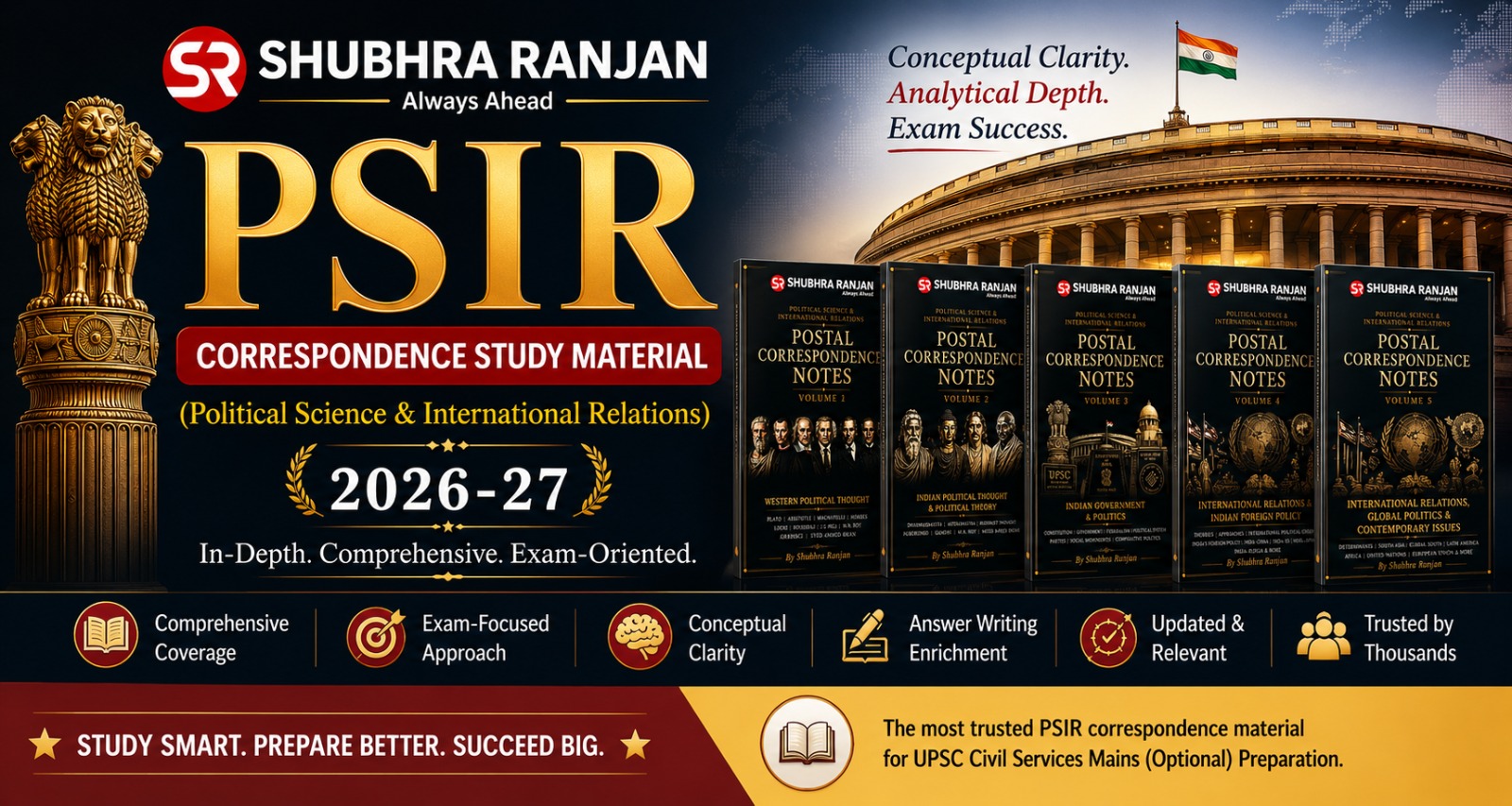
The correspondence material is organized into 5 volumes, covering important areas of Political Theory, Political Thought, Indian Government & Politics, International Relations and India’s Foreign Policy.
Why Choose Shubhra Ranjan PSIR Study Material?
PSIR is a subject where understanding concepts is just as important as their application in answers. The Shubhra Ranjan study material provides structured coverage of important topics and thinkers while helping aspirants connect theoretical concepts with contemporary political developments.
Key Features
Comprehensive coverage of the PSIR Optional syllabus
Structured and topic-wise presentation
Important Western and Indian political thinkers
Political theory and political ideologies
Indian Government and Politics
International Relations and Indian Foreign Policy
Conceptual and analytical approach
Useful for UPSC Mains answer preparation
Helps in building arguments and analytical perspectives
Suitable for self-study and systematic revision
Designed around UPSC-oriented preparation
Volume-Wise Overview
Volume 1 – Western Political Thought
Volume 1 focuses on Western Political Thought, an important component of PSIR Optional Paper I.
The volume covers major thinkers and political philosophers such as:
Plato
Aristotle
Machiavelli
Hobbes
Locke
Rousseau
- S. Mill
Karl Marx
Gramsci
Hannah Arendt
It also deals with important Political Ideologies, including:
Liberalism
Socialism
Marxism
Fascism
Neo-Marxism
Existentialism
Structuralism
Feminism
This volume can help aspirants understand the evolution of political ideas and develop comparative and analytical approaches for UPSC Mains answers.
Volume 2 – Indian Political Thought & Political Theory
Volume 2 covers Indian Political Thought along with important areas of Political Theory.
The Indian Political Thought section includes themes associated with:
Dharmashastra
Arthashastra
Buddhist Thought
Aurobindo
Mahatma Gandhi
- N. Roy
- R. Ambedkar
Syed Ahmed Khan
The Political Theory section covers important concepts such as:
Theory of State and Sovereignty
Concept of Power
Concept of Justice
Equality
Democracy
Theory of Rights
These topics are particularly useful for developing conceptual clarity and incorporating thinkers and theoretical perspectives into UPSC answers.
Volume 3 – Indian Government & Politics
Volume 3 focuses on Indian Government and Politics and provides coverage of major areas relevant to PSIR Paper II.
Important areas include:
Indian Nationalism
Making of the Indian Constitution
Salient Features of the Indian Constitution
Principal Organs of the Union Government
Principal Organs of State Governments
Grassroots Democracy
Statutory Institutions and Commissions
Federalism
Planning and Economic Development
Caste, Religion and Ethnicity in Indian Politics
Party System
Social Movements
Comparative Politics
The volume brings together constitutional, institutional and political dimensions required for a strong understanding of Indian politics.
Volume 4 – International Relations & Indian Foreign Policy
Volume 4 focuses on International Relations and Indian Foreign Policy.
Major areas include:
Theories of International Relations
Approaches to International Relations
Changing International Political Order
Key Concepts in International Relations
India’s Foreign Policy and the World
India-China Relations
India’s Act East Policy
India-US Relations
India-West Asia Relations
India-Japan Relations
India-Russia Relations
For PSIR aspirants, this section is especially useful for connecting theoretical approaches with India’s contemporary foreign policy and changing global dynamics.
Volume 5 – International Relations, Global Politics & Contemporary Issues
Volume 5 extends the International Relations coverage to broader global and regional themes.
Important areas include:
Determinants of Foreign Policy
South Asia
Global South
Latin America
Africa
Contemporary Global Concerns
United Nations
European Union
The volume helps aspirants develop a broader understanding of global politics and India’s position within the changing international system.
How This Material Can Help in UPSC PSIR Preparation
A successful PSIR preparation strategy requires more than simply reading individual topics. Aspirants need to understand the syllabus, identify recurring themes, connect thinkers with contemporary issues and practice presenting balanced arguments.
The Shubhra Ranjan PSIR Correspondence Study Material can be used as a core reference resource for systematically covering the syllabus.
- Build Conceptual Clarity
Political theory and political thought contain numerous abstract concepts. A structured resource can make it easier to understand concepts such as liberty, equality, justice, power, sovereignty, democracy and rights.
- Understand Political Thinkers
Thinkers form an important part of PSIR Optional. Studying them comparatively can help aspirants understand different perspectives and use relevant thinkers while constructing answers.
- Strengthen Indian Politics
The Indian Government & Politics section provides a foundation for understanding constitutional institutions, federalism, political parties, social movements and other important political developments.
- Improve International Relations Preparation
International Relations requires continuous linkage between theory and current developments. Topics such as India-China, India-US, India-Russia, India-Japan, West Asia, South Asia and global institutions can be approached through an analytical framework.
- Support Answer Writing
PSIR answers require clarity, structure, conceptual depth and relevant examples. Study material can provide the foundational content from which aspirants can develop their own introduction, arguments, examples, criticism and conclusions.
Who Should Use Shubhra Ranjan PSIR Correspondence Material?
This study material can be useful for:
UPSC Civil Services aspirants choosing PSIR as their Optional Subject
Candidates preparing for UPSC Mains
Beginners looking for structured PSIR coverage
Candidates revising Political Theory and Political Thought
Aspirants preparing Indian Government & Politics
Students strengthening International Relations preparation
Self-study aspirants looking for organized study material
Candidates looking to integrate static concepts with contemporary issues
Suggested Strategy for Using the Material
Aspirants can use the five volumes in a phased manner.
Step 1 – Understand the UPSC PSIR syllabus:
Before starting each topic, identify the corresponding syllabus area.
Step 2 – Read conceptually:
Focus on understanding rather than simply memorizing content.
Step 3 – Make concise revision notes:
Convert lengthy topics into short revision points, thinker comparisons, diagrams and frameworks.
Step 4 – Link with current affairs:
Especially for Indian Politics and International Relations, connect static concepts with contemporary developments.
Step 5 – Practice previous-year questions:
After completing a topic, solve relevant UPSC PSIR PYQs.
Step 6 – Develop answer frameworks:
Practice introductions, core arguments, examples, thinker references, criticism and conclusions.
Step 7 – Revise repeatedly:
PSIR benefits significantly from multiple rounds of revision because conceptual connections become stronger with repeated study.
Final Takeaway
The Shubhra Ranjan PSIR (Political Science) Correspondence Study Material 2026-27 brings together major components of the PSIR Optional syllabus across five volumes. From Western Political Thought and Indian Political Thought to Political Theory, Indian Government & Politics, International Relations and Indian Foreign Policy, the series provides a structured foundation for UPSC Mains preparation.
For aspirants who have selected Political Science & International Relations as their UPSC Optional Subject, systematic study, regular revision, current-affairs integration and continuous answer-writing practice remain essential. The five-volume correspondence material can serve as a comprehensive reference base throughout this preparation journey.
Shubhra Ranjan PSIR Correspondence Study Material 2026-27
Subject: Political Science & International Relations (PSIR)
Purpose: UPSC Civil Services Mains Optional Preparation
Format: Correspondence Study Material
Volumes: 5
Coverage: Political Thought, Political Theory, Indian Government & Politics, International Relations and Indian Foreign Policy
Session: 2026-27
Prepare systematically. Think analytically. Write effectively. Stay ahead with PSIR.
Website : www.sparklecopier.com
Contact No. 011-47053264, 9136659439
Shubhra Ranjan Notes 2026–27 | PSIR Optional – 5 Booklets (E)